
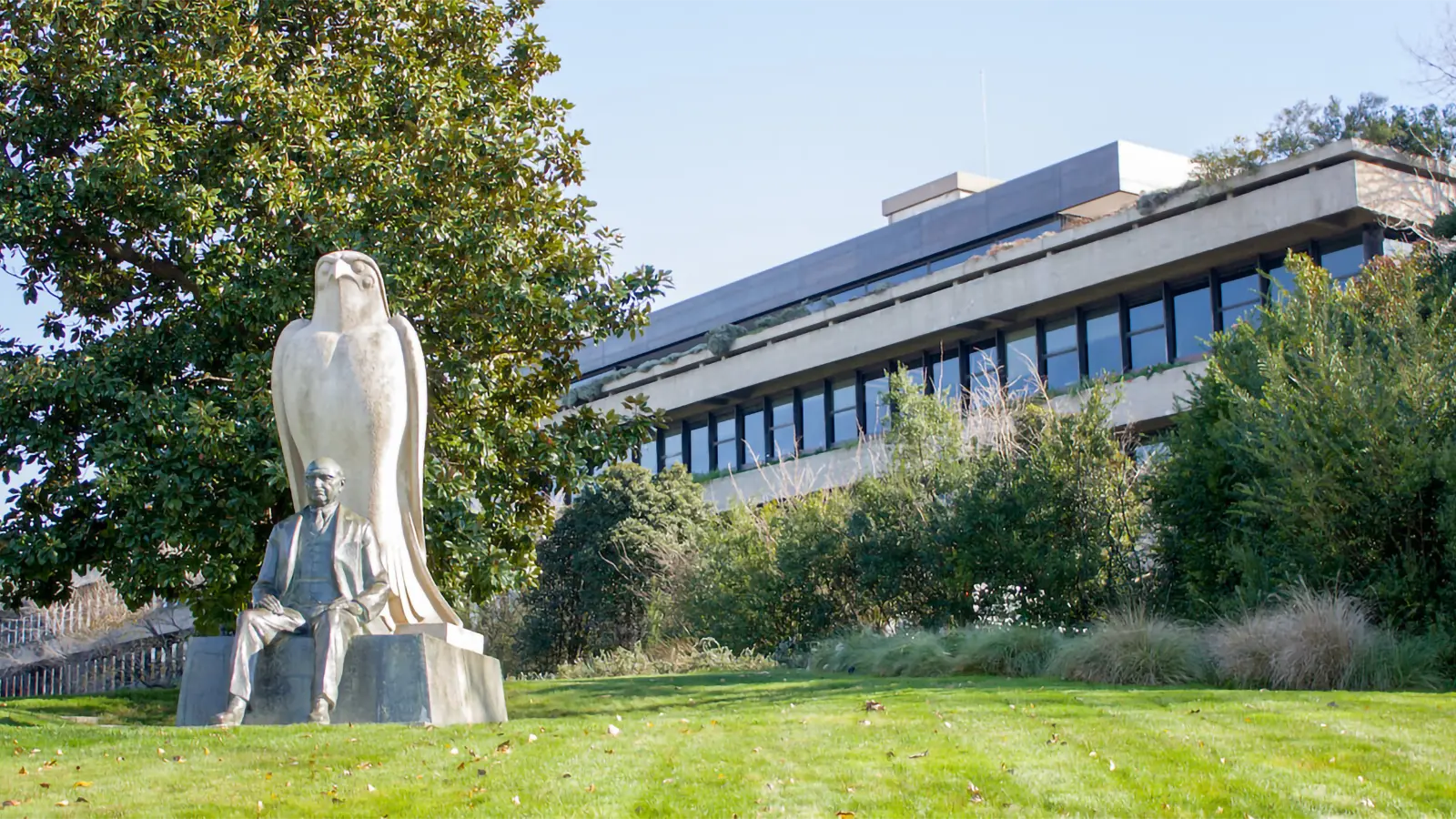
Lisbon’s Calouste Gulbenkian Museum has opened an exhibition that treats fashion and fine art as equals, positioning haute couture pieces alongside paintings, sculptures, and decorative objects spanning thousands of years.
The show, titled ‘Art & Fashion’, runs until 21 June 2026 and makes a case that the boundaries between these disciplines are essentially meaningless.
This spring has seen an unusual convergence of fashion-focused exhibitions globally. The V&A in London opened a major retrospective of Elsa Schiaparelli’s work, framed around her connections to the mid-20th century avant-garde.
The Metropolitan Museum’s Costume Institute is mounting its own exhibition titled ‘Costume Art’. In Lisbon, the Art & Fashion exhibition arrives in the same moment, suggesting something larger in the cultural conversation about how fashion should be understood and valued.
What the Exhibition Shows
The exhibition draws from the Gulbenkian’s permanent collection, assembled during the lifetime of Calouste Gulbenkian, an Armenian oil magnate and collector whose appetite for beautiful objects was rooted in Ruskin’s philosophy.
That philosophy held beauty as a moral imperative. With 6,000 pieces in its collection spanning the ancient world to the Impressionists, the museum has access to an unparalleled range of works that few institutions can match.
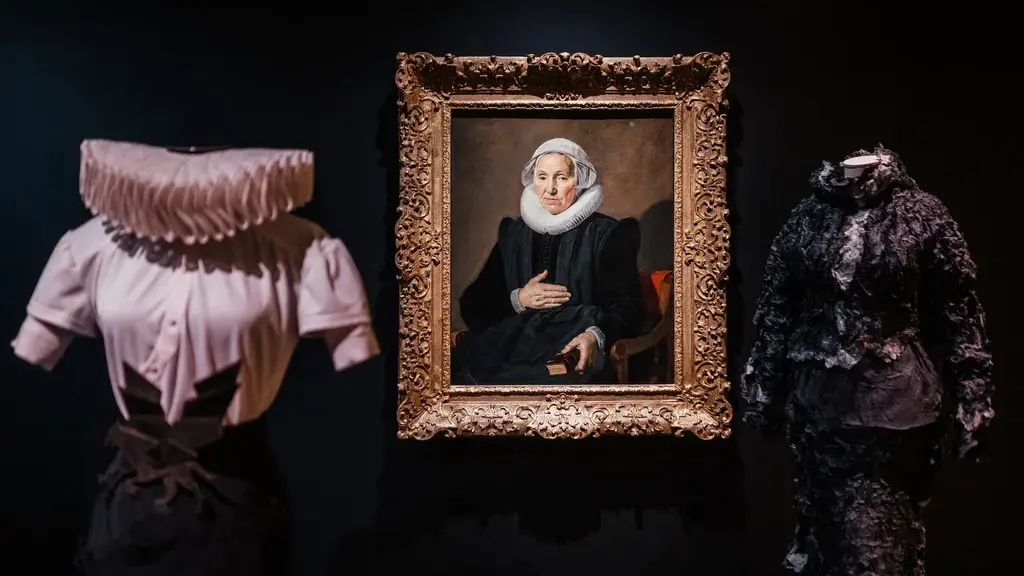
Pieces are grouped largely by regional provenance, creating unexpected juxtapositions. An ebony funerary statue from Thebes, Egypt, dating to between 2000 and 1990 BCE, appears next to a Yohji Yamamoto menswear look.
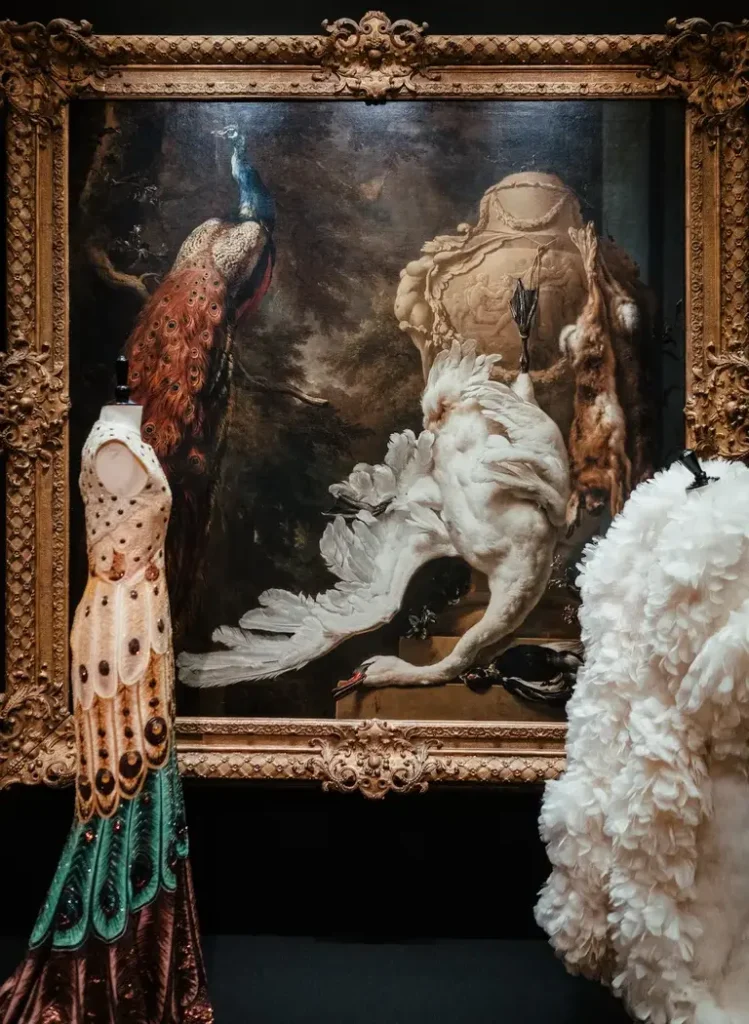
Fourteenth-century blue and white plates find their echo in an embroidered Dries Van Noten gown. A 1708 still life by Jan Weenix depicting a hunted swan appears near Manuel Pertegaz’s voluminous 1960 goose feather dress.
The Art & Fashion Exhibition’s Strongest Moments
The most literal comparisons yield immediate pleasure. A Renaissance composition reappears in a silk gown. A historical garment echoes the drapery in a centuries-old canvas. These moments demonstrate fashion as visual art.
The exhibition’s most thought-provoking pairings operate conceptually. Yves Saint Laurent’s 1968 Saharienne jacket appears alongside works by French Impressionists. Both are described as defiantly transgressive, both radical shifts in their respective disciplines.
Here the exhibition argues that fashion and painting can occupy the same intellectual and cultural territory.
How the Exhibition Frames Fashion
The exhibition makes a deliberate choice about what counts as fashion. Pieces are drawn almost entirely from luxury ready-to-wear and haute couture. Designers include Guo Pei, Romeo Gigli, Versace, Madame Grès, and Alaïa.
One small nod to popular fashion appears in the form of a shawl with traditional Nisa embroidery. Otherwise fashion is presented at its highest register.
Art is treated broadly. Beyond paintings and sculptures, the permanent collection includes applied and decorative works. An incredible wardrobe attributed to André-Charles Boulle from circa 1700 is rich with tortoiseshell and bronze marquetry.
Ceramics, textiles, furniture, and even a picnic set are included. By the exhibition’s logic, all beauty qualifies as art.
The exhibition concludes with Edward Burne-Jones’s ‘The Mirror of Venus’ from 1875, mirrored by a series of neo-classical gowns hung in a frieze-like composition. It is a deliberate echo of the Ruskin principles that shaped Gulbenkian’s collecting.
For those in Lisbon during the next eighteen months, the exhibition offers a chance to see how beauty operates across different forms.