
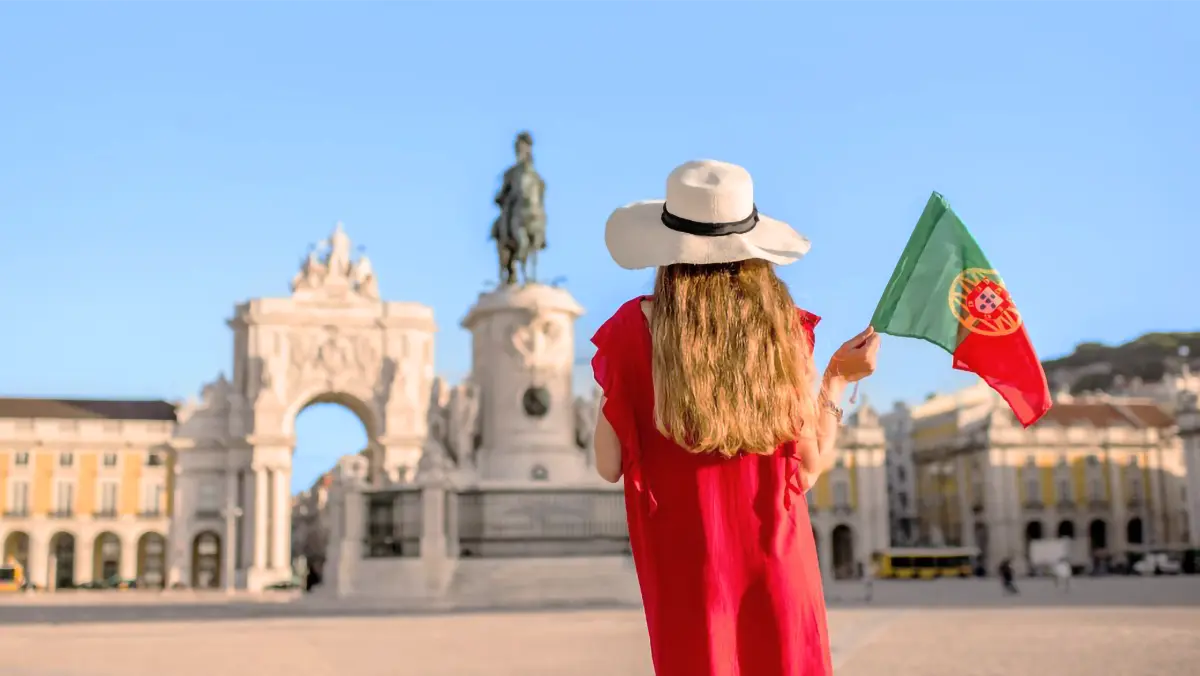
Families relocating to Portugal often cite the same handful of reasons: the weather, the safety, and the schools. The source material is correct on all counts. But what the statistics don’t capture is what daily life actually feels like when you arrive: the rhythm of it, the trade-offs, and the practical reality of raising children in a country that operates quite differently from most of Europe or North America.
The Climate and Outdoor Life
Three hundred days of sunshine is not marketing copy in Portugal; it is genuinely the case. More importantly, it changes how children spend their time. In many Northern European cities or North American suburbs, outdoor play is scheduled: soccer practice on Tuesday and park time on Saturday.
In Portugal, the default is simply outside. A child walks to school because the weather permits it year-round. Teenagers gather in squares in the evening because it is warm enough to do so. Parents sit at café tables with coffee while children play nearby, a social structure that older residents recognize but newcomers often find surprising in its casualness.
Winter in Portugal, even in the north, does not bring the extended darkness and cold that shapes much of Northern Europe. A family from Stockholm or Toronto experiences this as liberation. A family from Southern California may find it merely normal. The lifestyle shift is real but not universal in its impact.
Safety and Independence
Portugal’s ranking as the seventh safest country in the Global Peace Index is accurate. Children have genuine independence here. They walk or cycle to school, travel on buses alone, and spend afternoons unsupervised in parks in ways that would alarm many parents in higher-crime cities.
A parent from Lisbon or Porto will tell you they did not realize how much they had been managing their children’s movements until they stopped having to.
Safety in Portugal means a culture with low violent crime and social stability. It does not mean gated communities or car-dependent suburbs. It means street-level density, mixed neighborhoods, and public space that is genuinely public. Families expecting suburban safety with urban amenities sometimes find the balance requires adjustment.
Education and Healthcare
International schools operate throughout Portugal, and the quality varies considerably. British School of Lisbon, Saint Julian’s School (also in Lisbon), and Oporto British School in Porto are established choices, but proximity, philosophy, and cost differ sharply.
Many families also choose Portuguese public schools or bilingual options, a decision that requires research into individual schools rather than relying on general reputation.
Healthcare in Portugal is genuinely high-quality and far less expensive than in the United States or UK. The Serviço Nacional de Saúde (public system) is free for residents, though wait times for non-urgent procedures can be long.
Private healthcare is widely available and costs a fraction of American or British private care. Portuguese pediatrics and healthcare culture differ from what families may be accustomed to. Vaccination schedules differ, and communication styles are less detailed in some settings. The outcomes are strong.
What Relocating Families Often Overlook
The pace of life is genuinely slower, and this affects more than leisure. Bureaucracy moves differently. Schools close in August and for holidays in ways that do not align with international calendar expectations.
Many businesses close for lunch. Contractors and tradespeople keep their own schedules. Families accustomed to efficiency and predictability should prepare for both charming and frustrating moments.
Rental markets in desirable neighborhoods—Príncipe Real or Campo de Ourique in Lisbon, Cedofeita in Porto—are competitive and expensive by Portuguese standards but cheaper than comparable international neighborhoods.
Finding a home often requires patience and flexibility. Neighborhood choice shapes daily life significantly. Some areas offer the walkability and public life that make the Portuguese lifestyle distinctive, while others are more car-dependent and suburban.
Social integration requires intention. Portugal is welcoming but not automatically inclusive. Families who invest in Portuguese language, local friendships, and participation in neighborhood life settle much more successfully than those who remain in expat bubbles.
Schools, sports clubs, and neighborhood associations are where genuine integration happens.
For families considering relocation, the practical path forward involves visiting in different seasons, spending time in potential neighborhoods beyond the historic centers, meeting families already settled there, and understanding the specific neighborhood and school that will shape your daily experience.
Unlock the door to exclusive property opportunities in Portugal with our bespoke advisory services. We pride ourselves on providing objective, client-focused advice that empowers you to make informed decisions.
From market analysis to legal support, we cover every detail. Don’t miss out on your perfect Portuguese property, contact us to begin your journey.
